
How to Prevent Mice in the Kitchen: Food Storage, Sanitation, and Sealing
Stop mice from targeting your pantry, lower cabinets, and appliances using airtight food storage, appliance pull-out sanitation, and chew-resistant gap sealing aligned with CDC rodent control guidance.

Direct Answer: How to Keep Mice Out of the Kitchen
Kitchen mouse prevention requires three physical barriers: (1) transfer all dry pantry food, grains, and pet kibble out of cardboard or thin plastic into thick glass, metal, or rigid lidded containers; (2) remove night-time food rewards by cleaning crumbs and grease behind the stove, refrigerator, and toaster and using a covered trash bin; and (3) inspect openings around under-sink plumbing pipes, dishwasher lines, stove gas/electrical penetrations, and cabinet kickplates. CDC notes mice can fit through openings about 1/4 inch wide. Repair ordinary non-service structural gaps with suitable durable materials—never expanding foam alone. Do not pack conductive mesh into electrical openings or alter gas lines, vents, appliance clearances, or required drainage. Ask a qualified trade professional to repair utility and appliance penetrations (CDC Seal Up). Do not rely on peppermint oil or ultrasonic plug-ins, which are unproven deterrents that fail when food is accessible.
papalex-20 at no extra cost to you.
In This Kitchen Mouse-Proofing Guide:
- Interactive Kitchen Vulnerability & Sealing Audit Tool
- 1. Harden Pantry, Countertop & Pet-Food Storage
- 2. Deep Appliance Sanitation & CDC Wet-Cleanup Rules
- 3. Durable Kitchen Gap Sealing Matrix (Never Use Foam Alone)
- Video Guide: Sealing Under-Sink & Kitchen Cabinet Pipe Gaps
- 4. Why Peppermint Oil, Ultrasonic Devices & Glue/Live Traps Fail
- 5. Use a 7-Day Kitchen Monitoring Checkpoint
- Kitchen Proofing, Trapping & Cleanup Supplies
- Frequently Asked Questions
A kitchen can attract mice because it combines warmth from refrigerator compressors, concealed wall-void entry points behind lower cabinets, and calorie-dense food within inches of shelter. If you are already finding fresh droppings or gnawed food packages, combine the prevention steps below with our complete how to get rid of mice home plan and our mouse removal checklist.
1. Harden Pantry, Countertop & Pet-Food Storage
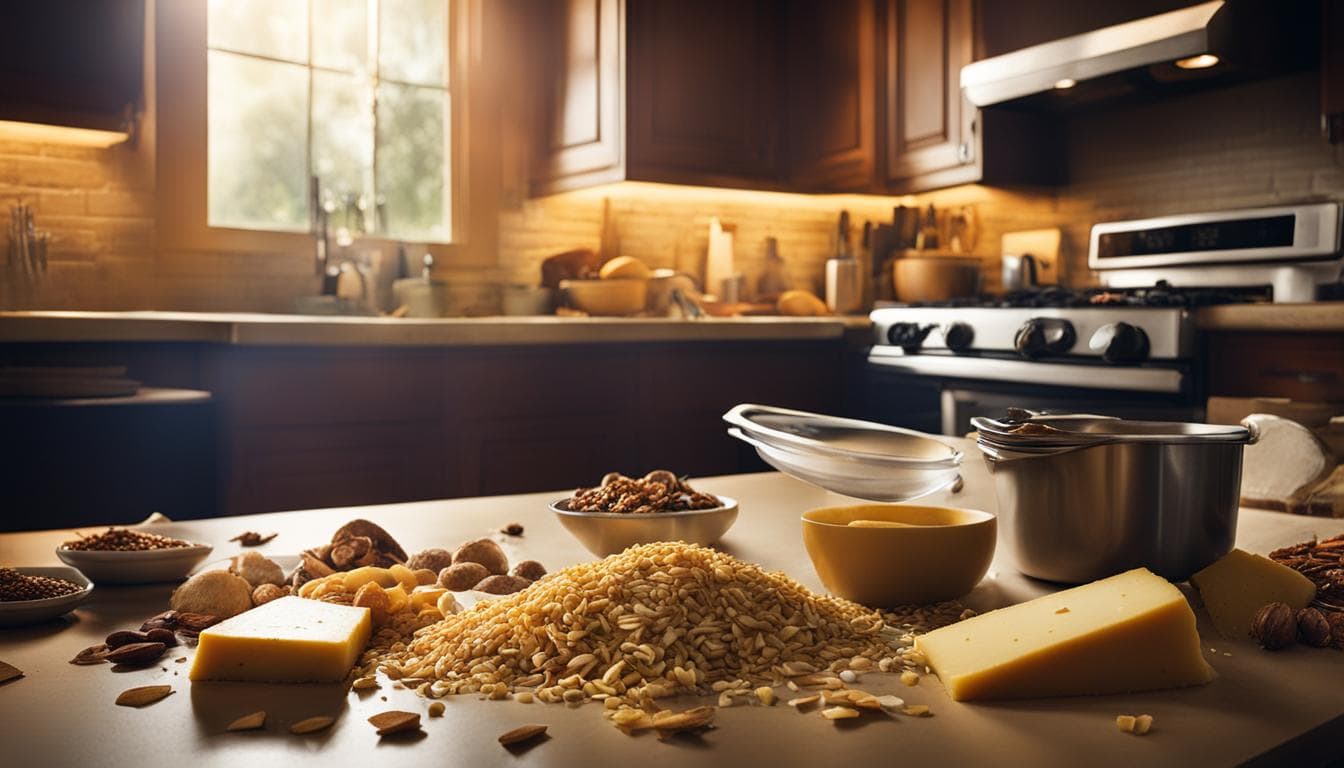
House mice can survive on limited food and can gnaw food packaging. Removing accessible food eliminates the foraging reward that keeps mice returning to kitchen shelves:
- Switch to chew-proof containers: Store cereals, pasta, rice, oats, flour, baking mixes, nuts, and crackers in glass jars with screw-top or clamp lids, metal canisters, or heavy-duty thick food-grade plastic bins.
- Lock down pet food overnight: Dry dog and cat kibble is one of the strongest rodent attractants in residential kitchens. Keep bulk pet food bags sealed inside a metal or thick rigid bin, pick up pet food bowls before bedtime, and wipe spilled kibble around feeding mats.
- Eliminate counter and fruit-bowl access: Store bread, tortillas, and ripening produce inside the refrigerator, a tightly closed bread box, or sealed containers rather than open baskets on the counter.
- Use a tight-fitting covered trash bin: Line kitchen trash and compost bins and keep them closed with a tight-fitting lid. Take kitchen trash out to a covered exterior bin nightly when rodent pressure is present.
2. Deep Appliance Sanitation & CDC Wet-Cleanup Rules
Wiping visible countertops is not enough if crumbs, cooking grease, and spilled dry goods accumulate in the dark gaps underneath and behind major appliances where mice actually travel:
- Clean accessible crumbs and grease. Do not move a connected gas range or service electrical components yourself; ask qualified help when safe access requires it.
- Clean toaster trays, air-fryer baskets, and pantry corners: Empty crumb trays daily and wipe pantry shelves where flour or grain dust settles (only when zero rodent droppings are present).
- Fix sink and dishwasher leaks: Repair slow P-trap drips under the kitchen sink and dishwasher supply valves so mice cannot use cabinet bases as a drinking source.
Found Droppings While Cleaning the Kitchen? Follow the CDC Wet-Cleanup Standard
Do not vacuum or sweep droppings, urine, or nests. Dry sweeping or vacuuming launches contaminated dust into the air. According to CDC Clean Up guidance:
- For a home or outbuilding, open doors and windows for 30 minutes and leave the area before cleaning.
- Wear rubber or plastic gloves. (A respirator, coveralls, and goggles are for heavy infestation cleanup, not a few pellets on a hard surface.)
- Spray droppings and contaminated surfaces with a household product whose label says “disinfectant,” or a fresh mix of 1.5 cups household bleach in 1 gallon of water (1 part bleach to 9 parts water).
- Let soak for 5 minutes, or for the contact time on the disinfectant label, then wipe up with paper towels and place all waste into a covered bin.
- Do not clean rodents out of heating or cooling ducts yourself. See our full step-by-step SOP: how to clean up mouse droppings safely.
3. Durable Kitchen Gap Sealing Matrix (Never Use Foam Alone)
Mice enter kitchens primarily from wall voids and subfloors through oversized cutouts hidden inside cabinets and behind appliances. Any gap 1/4 inch or larger (roughly the diameter of a pencil) is a possible entry point to inspect (CDC Seal Up).
| Kitchen Entry Point | Where to Inspect | Durable Chew-Resistant Sealing Method |
|---|---|---|
| Under-Sink Pipe Cutouts | Where hot/cold supply lines and the drain pipe pass through the back cabinet wall or floor. | Pack tightly with copper mesh or stainless steel wool, then seal edges with silicone or elastomeric caulk and fit a split metal escutcheon plate. |
| Dishwasher & Ice-Maker Lines | Side-wall pass-through holes between the sink base cabinet, dishwasher bay, and refrigerator. | Stuff copper mesh around the braided water line and drain hose; secure with caulk so mice cannot push the mesh out. |
| Range Gas & 240V Conduits | Floor or lower drywall opening behind the stove/oven. | Cover oversized floor cutouts with 1/4-inch galvanized hardware cloth or sheet metal collar, or pack smaller gaps with copper mesh and sealant. |
| Cabinet Toe-Kick Corners | Open gaps at the bottom corners where base cabinets meet walls or appliances. | Close open void corners with wood trim, metal flashing, or copper mesh + caulk after verifying no active mice remain inside. |
| Exterior Pantry / Mudroom Doors | Daylight visible beneath doors leading to the garage, basement, or backyard. | Install a heavy-duty metal-backed brush or rubber door sweep so the threshold gap is under 1/4 inch. |
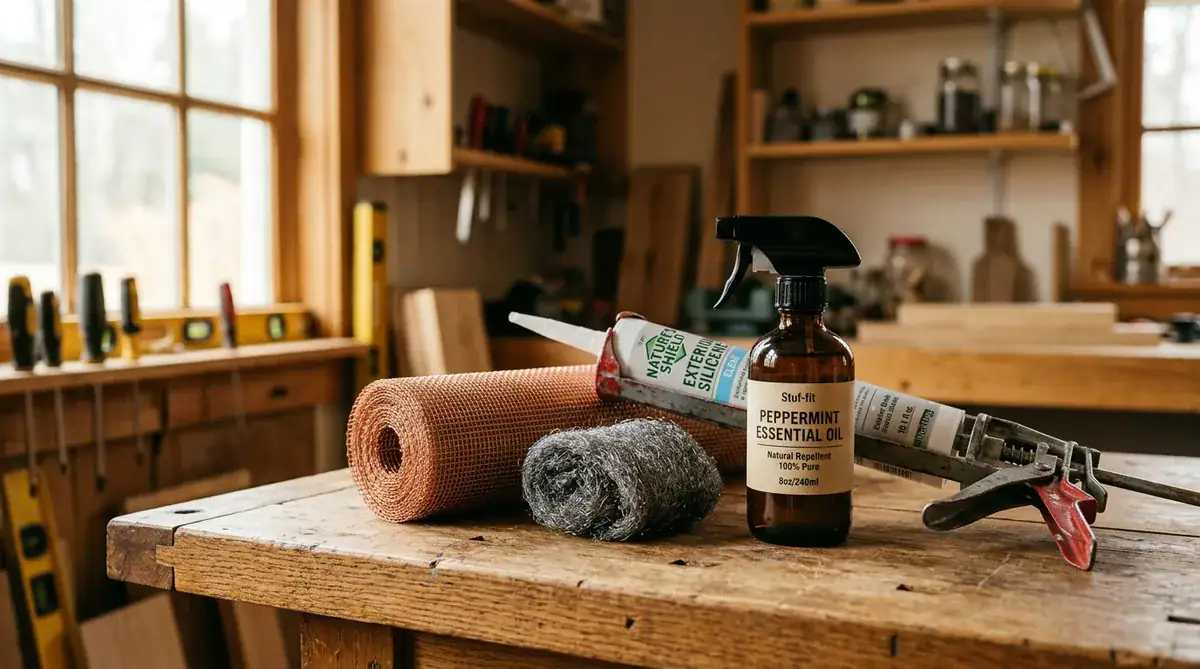
Why expanding spray foam fails on its own: Polyurethane spray foam is soft and easily chewed through by mice . Always pack the gap with chew-resistant copper mesh or steel wool first, or use 1/4-inch hardware cloth, and use caulk or sealant only to lock the metal mesh in place. Compare exclusion materials in our steel wool vs. copper mesh guide and our mouse proofing hub.
Video Guide: Sealing Under-Sink & Kitchen Cabinet Pipe Gaps
Watch this step-by-step demonstration on locating and sealing the hidden plumbing penetrations inside kitchen cabinets where mice enter:
4. Why Peppermint Oil, Ultrasonic Devices & Glue/Live Traps Fail in Kitchens
- Peppermint oil and botanical pouches are unproven: Essential oils evaporate rapidly and do not stop hungry mice from reaching pantry food or nesting behind warm appliances. Treating a kitchen with peppermint oil while pipe gaps and cereal boxes remain open delays effective control.
- Ultrasonic devices do not penetrate cabinets: High-frequency sound waves bounce off cabinet doors, appliances, and drywall, and rodents rapidly habituate to the noise.
- Do not use glue traps or live traps: The CDC explicitly advises against glue traps and live traps because caught, stressed rodents may urinate and increase household exposure to disease—especially dangerous near kitchen food-preparation surfaces.
- What to use if mice are already active in the kitchen: Use mouse-sized snap traps. Put a small amount of chunky peanut butter on the bait pan, set the trap against the wall, and put the baited end against the wall so it forms a T. Check daily. Keep traps and bait out of reach of children and pets (such as behind the refrigerator or stove, or inside a locked under-sink cabinet)—no trap is automatically pet-safe. See where to place mouse traps and best bait for mouse traps.
5. Use a 7-Day Kitchen Monitoring Checkpoint
After you seal under-sink and appliance gaps, store all food in hard containers, and trap any active mice, keep inspecting under the sink, behind the stove, and inside the pantry daily. A full week with no catches and no new signs is a monitoring checkpoint—not proof that mice cannot return if exterior or utility gaps stay open. Recheck pipe seals and door sweeps monthly.
Kitchen Hardware · Check Specifications
Kitchen Proofing, Trapping & Cleanup Supplies
Seal pipe penetrations with chew-resistant metal mesh, trap active mice behind appliances using mouse-sized snap traps, and wear disposable gloves during wet disinfection.
Affiliate disclosure: As an Amazon Associate, Mice Gone Guide earns from qualifying purchases (`?tag=papalex-20`) at no extra cost to you.

Xcluder Stainless-Steel & Poly Fiber Rodent Fill Fabric Kit
Pack tightly around under-sink plumbing pipes, dishwasher water lines, and cabinet pass-through holes before locking in place with caulk.
Check first: Wear gloves when cutting and packing stainless mesh; never use expanding foam by itself.
Check options on Amazon →
Pure Knitted Copper Mesh Rodent Control Roll
Rustproof copper mesh that conforms tightly around irregular plumbing escutcheons and damp under-sink cabinet penetrations ; check compatibility with the surface.
Check first: Pack firmly with a putty knife or screwdriver and seal over with silicone or elastomeric sealant.
Check options on Amazon →
Victor M156-20 Mouse-Sized Wooden Snap Traps (20-Pack)
Use if mice are already active inside the kitchen: bait with a pea-sized dab of chunky peanut butter and set in a T against the wall behind the stove or refrigerator.
Safety limit: Keep completely out of reach of children and pets and off all food-preparation counters. Check daily.
Check options on Amazon →Frequently Asked Questions
Does peppermint oil keep mice out of the kitchen?
No. Peppermint oil is an unproven deterrent that evaporates quickly and will not stop mice from entering a kitchen when food is accessible or pipe gaps remain unsealed. Reliable prevention requires airtight food containers, sanitation behind appliances, and sealing gaps 1/4 inch or larger with copper mesh or steel wool and caulk.
Where do mice enter the kitchen most often?
Kitchen entry points to inspect include oversized plumbing cutouts under the sink, dishwasher and refrigerator water-line pass-throughs, gas or electrical conduit openings behind the stove, and open gaps at the bottom corners of cabinet toe-kicks.
How should I clean mouse droppings inside kitchen cabinets?
Do not vacuum or sweep droppings dry. Open doors and windows for 30 minutes, wear rubber or plastic gloves, spray the droppings with a labeled household disinfectant or a fresh mix of 1.5 cups household bleach in 1 gallon of water (1 part bleach to 9 parts water), soak for 5 minutes (or the label time), and wipe with paper towels into a covered bin.
What traps should I use in a kitchen if mice are already inside?
Use mouse-sized snap traps baited with a small amount of chunky peanut butter and set in a T against the wall in areas out of reach of children and pets, such as behind the stove or refrigerator. The CDC advises against glue traps and live traps because stressed rodents may urinate and increase disease exposure.
References & Scientific Standards:

Alexios Papaioannou is the founder and lead editor of Mice Gone Guide. He oversees research, article review, and content updates focused on mouse prevention, humane control, home proofing, and safety-first household guidance.