
Wall Void Rodent Removal
How to Get Rid of Mice in Walls Safely
Direct Answer: Start with Accessible Evidence, Not Exploratory Holes
Do not cut exploratory holes based on sound alone. To eliminate mice, first inspect safely accessible areas beside the suspected wall, including cabinets, pipe gaps and appliance edges. If mouse activity is confirmed, use mouse-sized snap traps along evidence-supported routes, keep them away from children and pets and check daily.[2][4] Wet-clean accessible waste safely.[3] Do not put loose poison in a void: rodenticides can leave dead rodents inside a structure, creating odor or sanitation problems.[1]
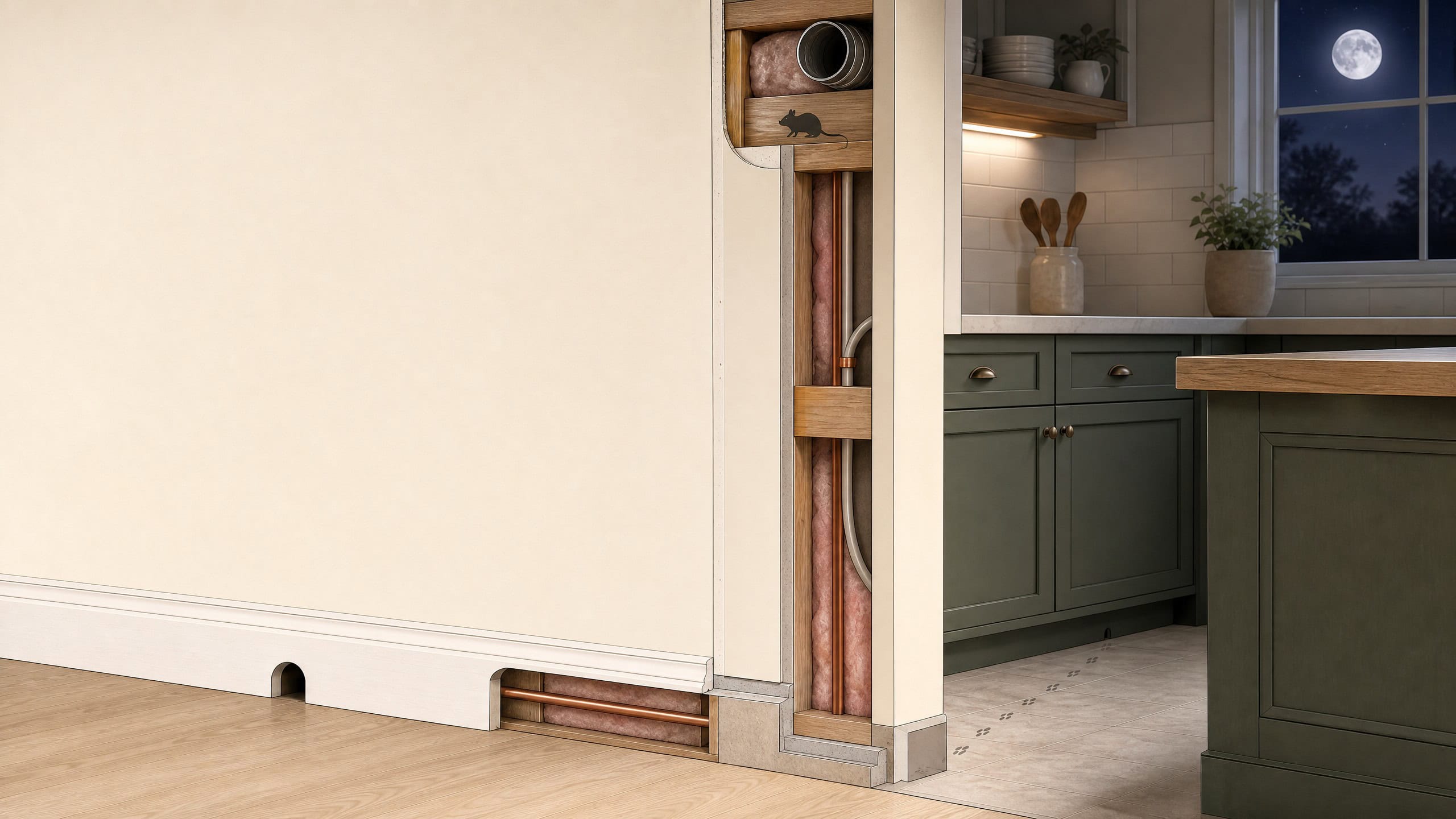
Hearing faint scratching behind your bedroom or kitchen drywall late at night is unsettling, but cutting random exploratory holes creates costly cosmetic damage without solving the root problem. Use the decision aid below to choose what to inspect next; it cannot pinpoint a cavity or route. To learn what the sounds themselves can and cannot tell you, see mouse noises in walls at night.
In This Wall-Removal Guide:
- The Sound-to-Evidence Decision Tree
- Wall-Noise Investigation Checklist
- What Wall Mice Evidence Actually Tells You
- Safe Wall-Mouse Action Plan (Step by Step)
- Where Wall Activity Connects to Living Spaces
- Video Guide: Accessible Trapping Near Suspected Wall Activity
- Void-Bait and Dead-Rodent Risks: What to Know
- Example 14-Day Observation Log (Not a Clearance Test)
- Critical Mistakes: What NOT to Do
- Frequently Asked Questions
The Sound-to-Evidence Decision Tree
Scratching sounds alone do not identify species or indicate whether demolition is needed. Follow this evidence sequence:
│
├── Have you found droppings, gnaw marks, or food damage nearby?
│ ├── YES: Record and safely clean accessible waste; check for new evidence. New rodent signs are consistent with current activity, but do not identify species or prove a wall exit. Choose suitable traps along confirmed travel routes.[5][2]
│ └── NO: No confirmed activity from sound alone. Record timing and inspect accessible areas:
│ ├── Nighttime (Observation only): Record where and when you hear it; seek physical evidence without assuming mice, rats or a specific cavity.
│ ├── Daylight / Mid-afternoon: Timing alone does not identify the animal or prove an eaves entry; seek qualified identification if physical evidence is unclear.
│ └── Rhythmic clicking when heat runs: Record whether the noise tracks heating operation; ask a qualified building professional to assess a possible mechanical source.
What Wall Mice Evidence Actually Tells You
| Evidence Found | What To Investigate Next | What It Does NOT Prove |
|---|---|---|
| Droppings along adjacent baseboard | Document suspected waste and check for new deposits after safe cleanup; this may support current rodent activity.[5] | Does not identify species, population size, a wall exit or an exterior entry hole. |
| Scratching behind kitchen wall | Inspect accessible cabinet and baseboard areas for corroborating evidence; a sound cannot pinpoint a travel corridor. | Does NOT mean you need to cut open the drywall. |
| Persistent unpleasant odor near wall | Ask for qualified assessment of the odor source; smell alone cannot identify a dead mouse or its location. | Does not establish a carcass, its species, a cavity location, disease risk or whether activity continues. |
Safe Wall-Mouse Action Plan (Step by Step)
- Map all adjacent rooms: Inspect lower cabinets, pantry shelving, and appliance voids directly opposite the noisy wall section.
- Cut off food rewards: Store dry food in thick plastic, metal or glass containers with tight lids.[4] Reducing food access supports control; it does not guarantee trapping success.[4][1]
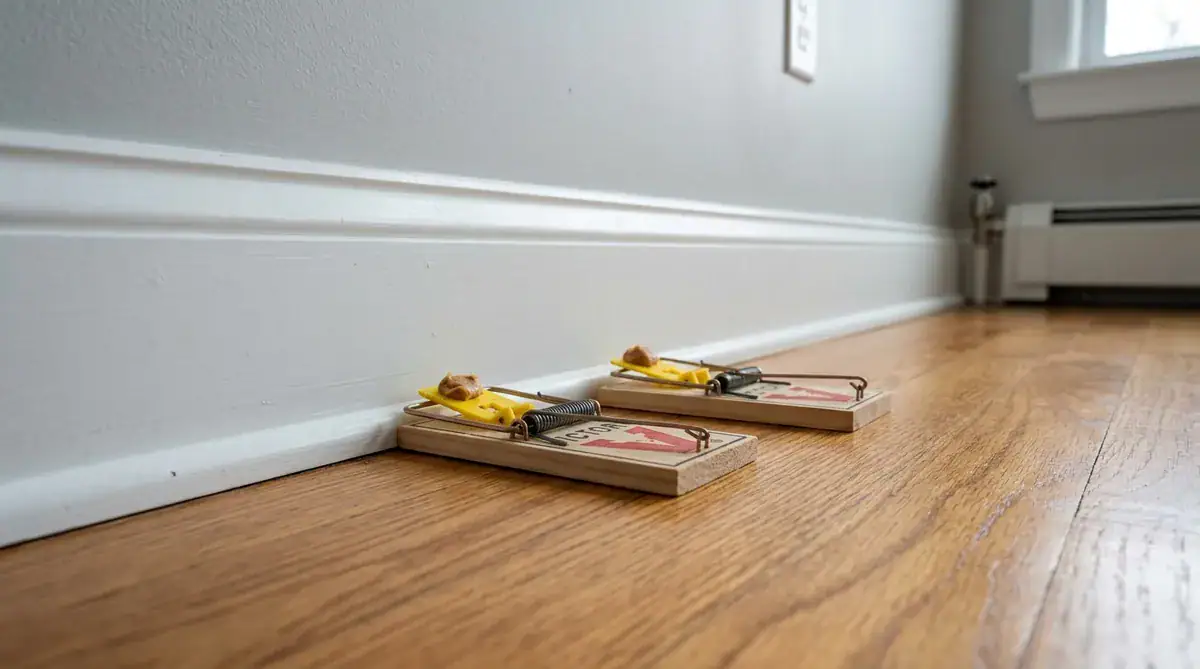
- Deploy mechanical snap traps along baseboards: For confirmed mouse activity, follow the trap instructions and place traps perpendicular to evidence-supported wall routes, baited end toward the wall. Keep traps away from children and pets and check daily.[2] Review traps in our best mouse traps guide.
- Wet-clean visible droppings safely: Follow CDC ventilation and rubber/plastic glove precautions. Wet waste thoroughly with an appropriate disinfectant and let it soak for 5 minutes or the label time before wiping; do not dry-sweep or vacuum untreated waste.[3] See safe droppings cleanup.
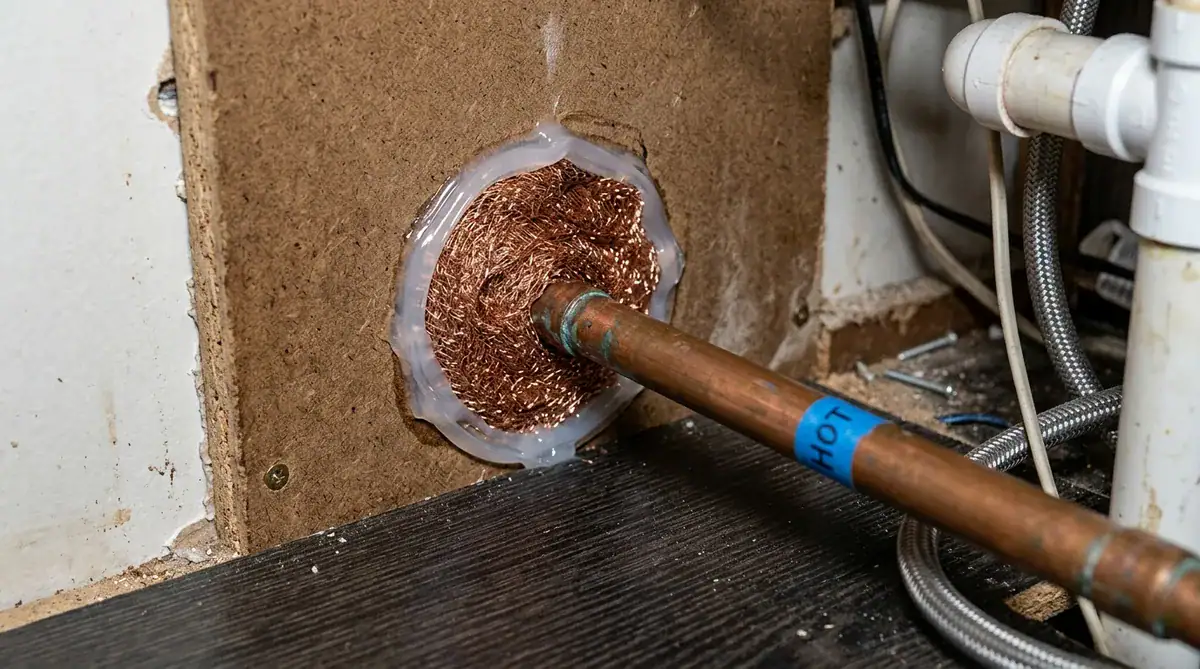
- Seal exterior wall penetrations: Inspect and repair suitable entry gaps as part of control while continuing to trap rodents that may remain indoors; do not use five catch-free days as a clearance test. Choose gnaw-resistant repairs appropriate to the opening, and obtain qualified help around utilities. Do not block ventilation, drainage or weep openings.[4][1] See steel wool vs copper mesh.
Video Guide: Accessible Trapping Near Suspected Wall Activity
This existing video accompanies the guide to eliminate mice ; it does not verify a wall nest, promise non-destructive access or establish success in your home. Follow the safety guidance above.
Void-Bait and Dead-Rodent Risks: What to Know
Do not throw loose poison into wall voids. UC IPM notes that rodents poisoned inside buildings may die within the structure and create odor or sanitation problems; accessible trapping allows carcass removal. Any pesticide use must follow its label and protect children, pets and wildlife. Persistent odor or inaccessible contamination needs qualified assessment; neither odor nor a timetable establishes a safe waiting period.[1][4]
Example 14-Day Observation Log (Not a Clearance Test)
These rows are illustrative, not site results or a clearance test. The example trap count is not a universal quantity. Check traps daily and log new signs after safe cleanup; a lack of catches or quiet walls alone cannot establish that every rodent is gone.[2][5]
| Day | Location Checked | Evidence Observed | Action Executed | New Signs? |
|---|---|---|---|---|
| Day 1 | Kitchen wall behind stove | 3 suspected droppings of unknown age; scratching sound | Wet-cleaned; set 2 perpendicular snap traps | First observation; no prior check |
| Day 3 | Same location | 1 mouse captured in snap trap | CDC wet disinfection and double-bagged disposal; re-baited trap[3] | No new droppings |
| Day 7 | Under-sink cabinet | No sound recorded; no catches at daily checks | Checked entry repairs; continued daily trap checks | No new signs recorded |
Critical Mistakes: What NOT to Do
- ❌ Do NOT cut exploratory holes into drywall based purely on sound.
- ❌ Do NOT throw poison blocks into walls, because poisoned rodents may die in inaccessible areas.[1]
- ❌ Do NOT rely on expanding foam alone for rodent exclusion; select suitable gnaw-resistant repairs.[1][4]
- ❌ Do NOT dry-sweep or vacuum rodent feces along baseboards.[3]
Can Mice Climb Walls? (Why Vertical Access Matters)
Yes. UC IPM describes house mice as excellent climbers able to run up rough vertical surfaces. This means an inspection should not be limited to foundation-level openings, but climbing ability does not establish the entry point in your home.[1]
Practical takeaway: inspect safely visible exterior gaps at low and high levels, including eaves and soffits. Use qualified help for high or unsafe access. Do not indiscriminately seal ventilation or drainage openings.[4]
Mice problem action box
Choose evidence-led DIY control or qualified professional help.
DIY trapping may be an option when rodent evidence is confirmed and trap locations are safely accessible. Recurring signs, uncertain identification, damaged wiring, contaminated ducts or inaccessible waste call for qualified help. Sounds alone do not establish an infestation or its size.[1][3][4]
As an Amazon Associate, Mice Gone Guide earns from qualifying purchases, at no extra cost to you.
Disclosure: Some product links may be affiliate links. If you buy through them, we may earn a commission at no extra cost to you. For heavy contamination or unsafe access, contact a qualified professional. If you feel ill after possible rodent exposure, tell a healthcare provider about that exposure.[3]
Frequently Asked Questions
Can mice live in walls permanently?
Mice may use sheltered spaces for nesting, but sounds alone do not establish a wall nest. House mice can obtain moisture from food and do not necessarily leave daily to drink. Inspect accessible areas for evidence and use suitable traps on confirmed routes rather than assuming a particular exit.[1][2]
How do I get rid of a dead mouse in the wall?
Smell alone cannot establish a carcass or pinpoint a cavity, and there is no universal safe waiting period. Do not cut into a wall based on odor alone. Ask a qualified professional to assess persistent odor, inaccessible contamination and safe access around wiring, plumbing or structural components.[1][4]
How do I trap mice inside walls?
Start with accessible locations where mouse evidence supports placement, such as baseboards, cabinets and spaces behind appliances. Use mouse-sized snap traps according to their instructions, baited end toward the wall, away from children and pets; check daily. A sound does not prove a wall exit. Seek qualified help for inaccessible activity.[2][4]
References & Safety Standards:
Wondering how they got in? Mice climb textured walls — the can mice climb walls guide shows which surfaces give them purchase and how to block the routes.




Alexios Papaioannou is the founder and lead editor of Mice Gone Guide. He oversees research, article review, and content updates focused on mouse prevention, humane control, home proofing, and safety-first household guidance.