
Disclosure: this page contains affiliate links. As an Amazon Associate, Mice Gone Guide earns from qualifying purchases, at no extra cost to you.
Mice problem action box
Need mice gone fast? Choose DIY control or professional help before activity spreads.
DIY trapping can work for light activity, but recurring droppings, attic noises, wall sounds, insulation contamination, or mice returning after sealing may require a professional inspection. Use the checklist below to act quickly and safely.
Disclosure: Some product links may be affiliate links. If you buy through them, we may earn a commission at no extra cost to you. For heavy contamination, illness risk, or unsafe areas, contact a qualified professional.
How to Get Rid of Mice in Walls: Safe, Non-Destructive Method
Stop scratching noises in drywall without tearing open walls or using poison. Follow our exterior-interior trapping protocol with zero drywall destruction.
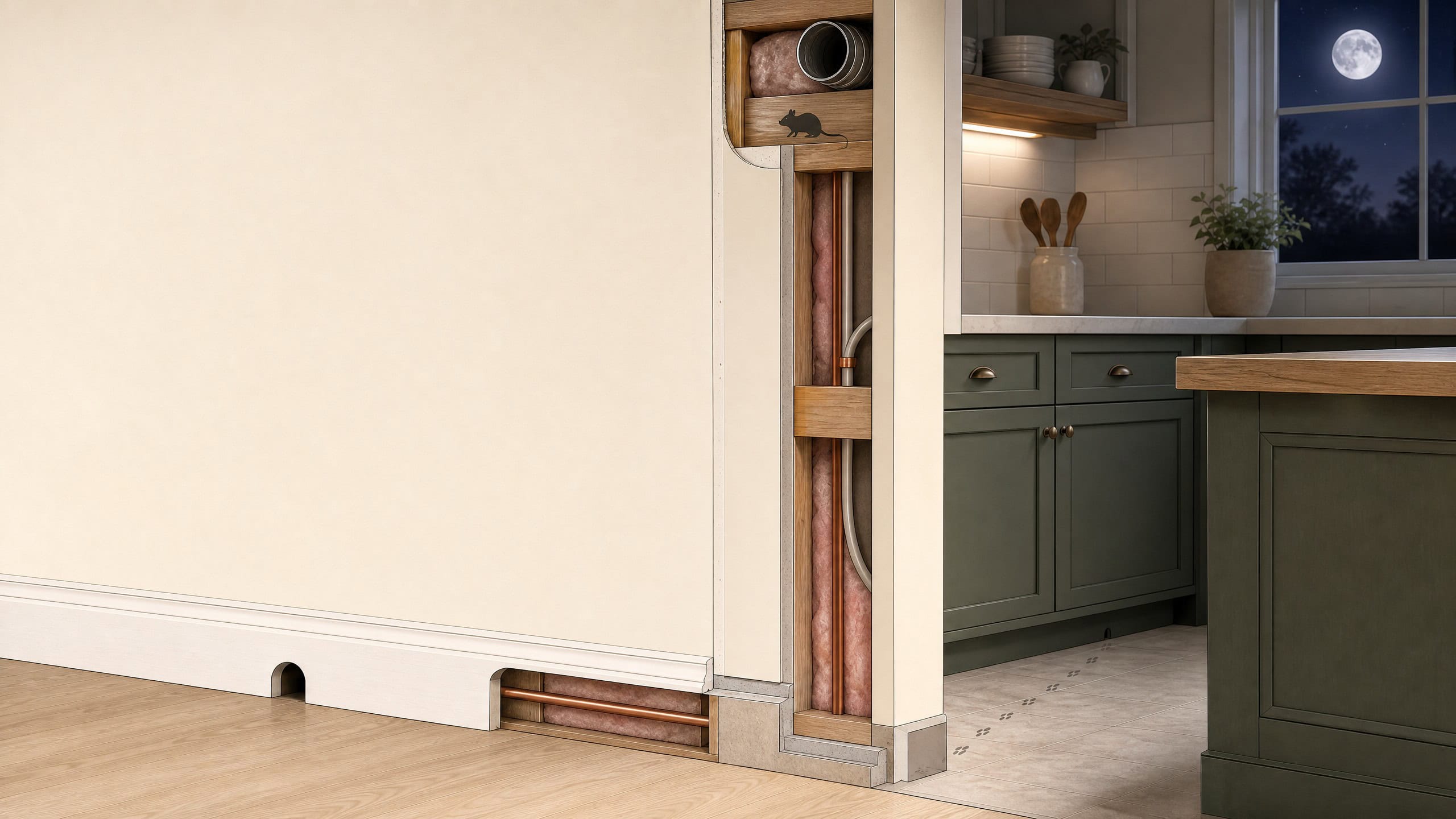
Direct Answer: Do NOT Tear Open Your Drywall
You almost never eliminate mice in walls by cutting into drywall. Mice commonly use wall voids for travel and nesting, and may leave to reach food and water. Start by inspecting accessible edges on either side of the wall: behind kitchen appliances, under-sink plumbing gaps, and pantry baseboards. Place mechanical snap traps perpendicular against these exit runways, wet-clean visible waste, and seal confirmed exterior entry gaps after activity is controlled. Do not place loose poison into wall voids: a rodent may die where it cannot be removed, creating an odor and contamination problem.
Hearing faint scratching behind your bedroom or kitchen drywall late at night is unsettling, but cutting random exploratory holes creates costly cosmetic damage without solving the root problem. Use the evidence-based decision tree below to pinpoint the route. To learn what the sounds themselves can and cannot tell you, see mouse noises in walls at night.
In This Wall-Removal Guide:
- The Sound-to-Evidence Decision Tree
- Interactive Wall Scratching Sound Triangulator
- What Wall Mice Evidence Actually Tells You
- Safe Wall-Mouse Action Plan (Step by Step)
- Where Wall Activity Connects to Living Spaces
- Video Guide: Trapping Wall Mice Without Demolition
- Void-Bait and Dead-Rodent Risks: What to Know
- 14-Day Outcome-Check Log: Monitor Without Guessing
- Critical Mistakes: What NOT to Do
- Frequently Asked Questions
The Sound-to-Evidence Decision Tree
Scratching sounds alone do not identify species or indicate whether demolition is needed. Follow this evidence sequence:
│
├── Have you found droppings, gnaw marks, or food damage nearby?
│ ├── YES: Active route confirmed! Deploy perpendicular snap traps along adjacent baseboards.
│ └── NO: Do not assume mice yet. Check sound timing:
│ ├── 11 PM – 3 AM (Clue only, not proof by itself): Nighttime scratching suggests nocturnal rodents (mice or rats), bats, or settling pipes—confirm with physical droppings or gnaw marks.
│ ├── Daylight / Mid-afternoon: Likely squirrels, birds, or chipmunks entering from eaves.
│ └── Rhythmic clicking when heat runs: Thermal expansion of plumbing/baseboard pipes.
What Wall Mice Evidence Actually Tells You
| Evidence Found | What It Directly Points To | What It Does NOT Prove |
|---|---|---|
| Droppings along adjacent baseboard | Mice are actively emerging from wall into the room. | Does not pinpoint the exterior entry hole. |
| Scratching behind kitchen wall | Travel corridor between cabinet base and wall stud. | Does NOT mean you need to cut open the drywall. |
| Pungent dead-rodent odor in wall | A mouse died in a stud cavity (often from bait). | Does not mean an active infestation remains. |
Safe Wall-Mouse Action Plan (Step by Step)
- Map all adjacent rooms: Inspect lower cabinets, pantry shelving, and appliance voids directly opposite the noisy wall section.
- Cut off food rewards: Store all dry food in airtight glass or rigid plastic containers. Mice will ignore traps if cereal boxes remain accessible.
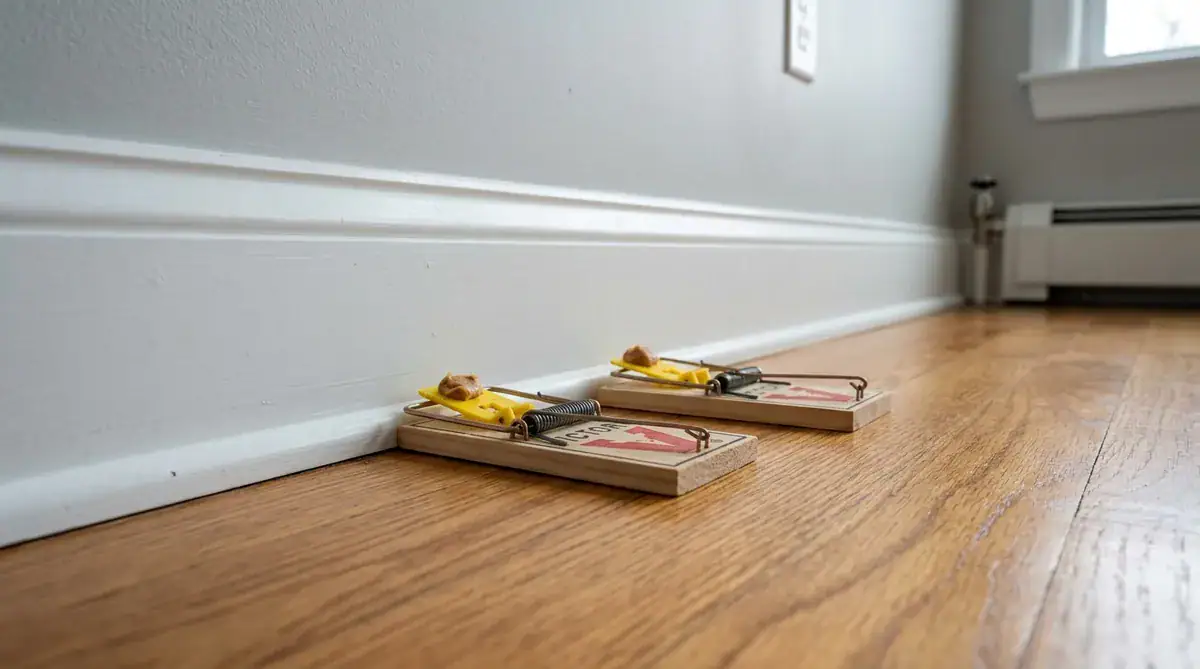
- Deploy mechanical snap traps along baseboards: Place traps perpendicular to walls with the baited trigger facing the baseboard. Use pea-sized peanut butter. Review traps in our best mouse traps guide.
- Wet-clean visible droppings safely: Follow CDC protocols by soaking droppings with disinfectant for 5 minutes before wiping. See safe droppings cleanup.
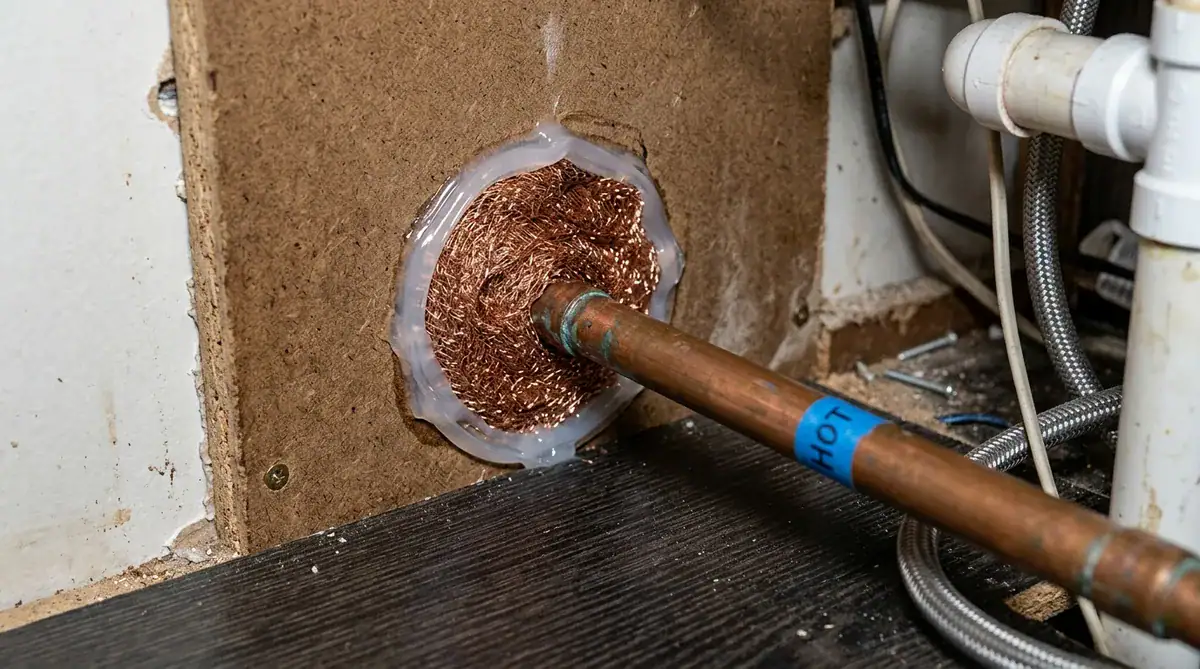
- Seal exterior wall penetrations: Once trapping captures stop for 5 consecutive days, pack exterior gaps around AC conduits, gas lines, and siding with copper mesh. See steel wool vs copper mesh.
Video Guide: Trapping Wall Mice Without Demolition
Watch how professional pest technicians eliminate mice from interior wall voids without cutting drywall:
Void-Bait and Dead-Rodent Risks: What to Know
Homeowners frequently throw poison pellets into wall voids hoping for a quick fix. When a poisoned rodent dies inside a wall, the rotting carcass emits a putrid odor that lasts 2 to 3 weeks and cannot be cleaned without cutting drywall. Mechanical traps outside the wall provide rapid physical removal without the rotting carcass problem.
14-Day Outcome-Check Log: Monitor Without Guessing
| Day | Location Checked | Evidence Observed | Action Executed | New Signs? |
|---|---|---|---|---|
| Day 1 | Kitchen wall behind stove | 3 fresh droppings, scratching sound | Wet-cleaned; set 2 perpendicular snap traps | Yes |
| Day 3 | Same location | 1 mouse captured in snap trap | Double-bagged disposal; re-baited trap | No new droppings |
| Day 7 | Under-sink cabinet | No sound; traps untouched | Packed pipe gap with copper mesh and silicone | No |
Critical Mistakes: What NOT to Do
- ❌ Do NOT cut exploratory holes into drywall based purely on sound.
- ❌ Do NOT throw poison blocks into walls, which produces trapped decaying carcasses.
- ❌ Do NOT spray foam into exterior holes without copper mesh (mice easily gnaw cured foam).
- ❌ Do NOT dry-sweep or vacuum rodent feces along baseboards.
Can Mice Climb Walls? (Why Vertical Access Matters)
Yes — mice climb walls easily when the surface gives any grip. A house mouse can scale brick, stucco, rough concrete, wood siding, and even slightly textured vinyl at near-vertical angles, using claws and a tail built for balance. Smooth surfaces like glass, glossy tile, and polished metal stop them. That matters for wall infestations because entry gaps are rarely at floor level: a mouse climbs an exterior wall, slips through a weep hole, soffit vent, or siding seam two stories up, and the wall void becomes a highway to your attic and kitchen.
Practical takeaway: when you hear rustling inside a wall, inspect the upper exterior walls for entry gaps — not just the foundation — and seal findings with copper mesh plus caulk as described above.
Frequently Asked Questions
Can mice live in walls permanently?
No. While mice nest in wall voids, they must leave to drink and feed daily. Placing traps along the baseboards where they exit is the most reliable way to catch them.
How do I get rid of a dead mouse in the wall?
The odor naturally dissipates in 7 to 14 days as the body dries out. Use activated charcoal bags and open windows to mitigate the smell. Only open drywall if the odor is overwhelming and precisely located.
How do I trap mice inside walls?
Trap them at their exit runways: behind refrigerators, beneath kitchen sinks around pipe penetrations, and along baseboards.
References & Safety Standards:
Wondering how they got in? Mice climb textured walls — the can mice climb walls guide shows which surfaces give them purchase and how to block the routes.

Alexios Papaioannou is the founder and lead editor of Mice Gone Guide. He oversees research, article review, and content updates focused on mouse prevention, humane control, home proofing, and safety-first household guidance.